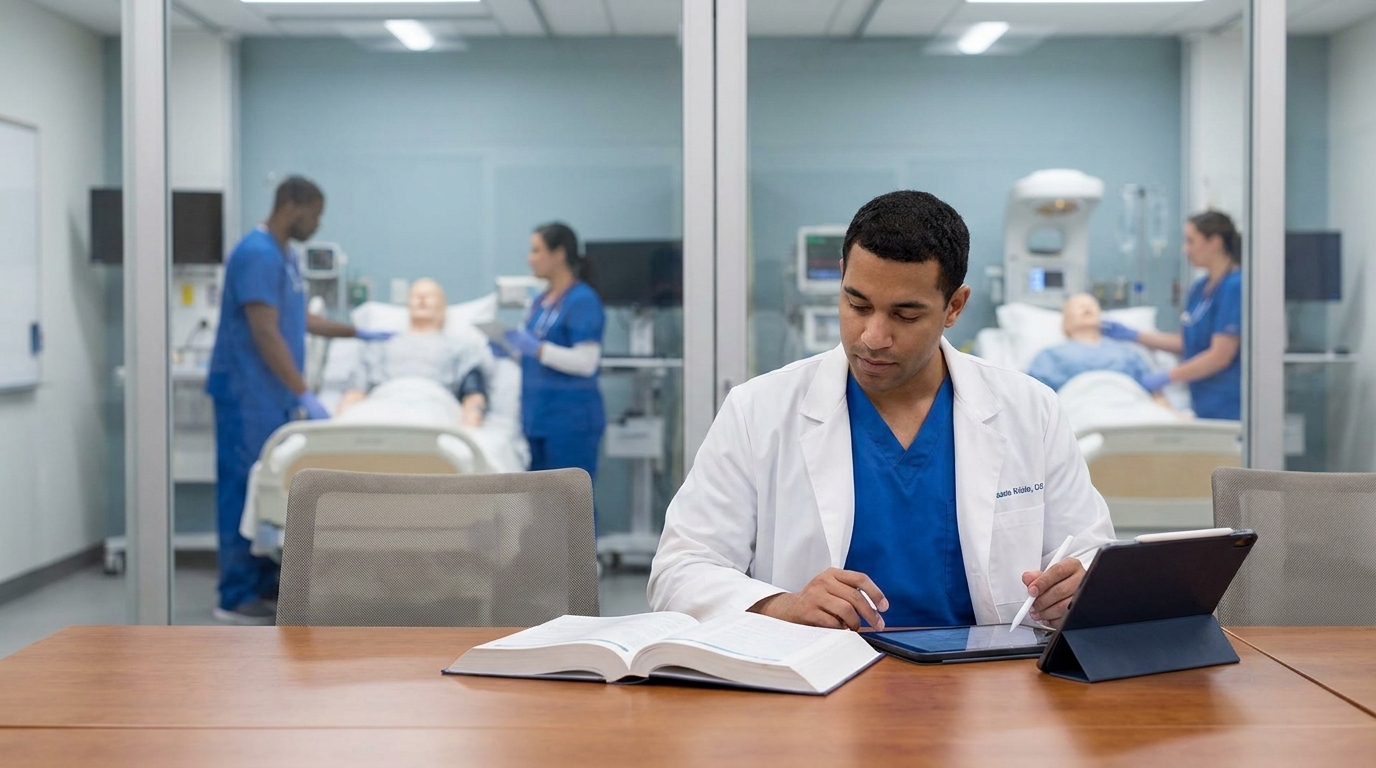
Clinical education in nursing has become a spectator sport.
When I was a nursing student, clinical meant you did things. You assessed patients. You titrated drips. You made decisions while someone experienced stood close enough to catch you if you were wrong. That was the whole point. It worked because the doing was the learning.
The generation before mine had it even more so. My mother trained in a hospital diploma program. She called her student clinical experience “slave labor for the hospital.” I’ve heard that same line from plenty of diploma-era nurses. Say what you will about that model, she was a hell of a nurse.
How the Loop Started
Something shifted over the past 20 years. The liability environment got tighter. Hospitals got nervous about students touching patients. Nurses got nervous too. So students watched.
Those students graduated, became nurses, and too quickly got students of their own. What did they model? The only thing they knew. Watching. It became a generational feedback loop where each cohort produces nurses with less hands-on experience, who then train the next cohort the exact same way.
There’s also a reality that nobody wants to say out loud. Having a student is hard. It increases the cognitive load on a nurse who’s already drowning. An understaffed unit, high-acuity patients, a twelve-hour shift where you’re barely keeping your head above water, adding a learner to that equation isn’t a teaching opportunity. It’s one more thing to manage. The path of least resistance is always the same: I’ll just do it myself.
So what do students end up doing? Giving meds.
Nurses who are busy and overwhelmed love it when students give meds, because medication administration offloads a massive chunk of morning work onto another competent nurse, the clinical instructor. Students are happy to oblige. After all, that’s what being a nurse really is. Right?
It’s not the useless stuff they learn in class, like recognizing when a patient is starting to decompensate before the monitor catches it. Or figuring out why a heart rate is climbing when the vitals look otherwise fine. Or knowing the difference between a patient who says “I’m okay” and a patient who actually is.
Giving meds takes time. It requires careful thinking about safety, interactions, and the patient’s response. Students equate that time with importance. And it is important. Nobody is arguing against it.
But the act of signing out the medication, handing it to the patient, and documenting that it was given can be done by a robot. And it soon will be.
What’s Getting Lost
Pattern recognition in clinical settings doesn’t develop through observation. It develops through practice.
The NP who can walk into a room and know in 90 seconds whether a patient is compensated or about to not be didn’t get that from watching someone else do it. She got it from doing it hundreds of times, getting it wrong occasionally, having someone correct her in real time, and building the neural map that makes the assessment automatic.
That map takes time to build. It requires repetition across different patients, different presentations, different contexts. A student who observes 50 assessments develops some pattern recognition. A student who performs 50 assessments, gets corrected, and gets immediate feedback develops significantly more.
The difference matters enormously at the transition from student to independent practitioner. A new graduate nurse who spent three years of clinical doing things has a head start that takes the observational cohort 12 to 18 months to close. During those 12 to 18 months, the learning curve is not invisible.
What the Fix Requires
It has to happen at clinical sites.
Students need to do things that matter. Make low-stakes decisions. Get corrected in real time. Build the clinical reasoning that only comes from repetition across enough patients that the patterns become recognizable.
That means preceptors who commit to active supervision rather than parallel work. Faculty who design clinical objectives around doing, not observing. Sites who understand that the short-term inconvenience of active student participation produces better nurses who function more independently after graduation, which is very much in the hospital’s interest.
It means accepting that an actively supervised student who makes a supervised mistake is learning something that will protect patients for 30 years. A passively observing student who makes no mistakes is learning to observe.
Julie Siemers wrote recently that the competency crisis in nursing education is not a content problem, it’s a cognitive one. She’s right. The content is there. The clinical reasoning has to be practiced. The observation model doesn’t practice it.
The fix isn’t complicated. It’s just slower and harder than watching from the hallway.